Mariabronn
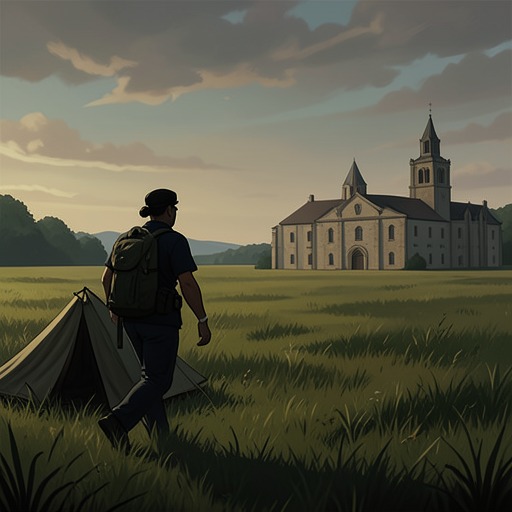
Narcissus and GoldmundMariabronn is a cloister, school, and artistic community whose significance changes with Goldmund’s life: first the ordered world of his education, then a powerful landscape of memory, and finally the home where he can work again. Its enduring structures and inherited works make the place more than a backdrop; they embody a continuity of religious and communal life against which Goldmund measures his unsettled existence.
The Cloister and Its Community
Mariabronn holds many kinds of activity within its walls. Its cells, halls, classrooms, and refectory serve teaching, administration, worship, and daily communal life. Books are written and annotated, old texts collected and illuminated, and religious instruction exists alongside worldly learning and other forms of study. The balance among these pursuits changes with the abbot and the prevailing interests of the time. At different moments the cloister is known for exorcism and the detection of demons, fine music, a monk reputed to heal, or the food served in its refectory. Its identity is therefore not reducible to a single specialty: it is a durable institution whose varied practices are renewed across generations.
That generational continuity is visible in the boys who pass beneath the chestnut tree at the entrance. Some remain, become novices and monks, and grow old within the community; others leave after their studies to return to their families, pursue crafts, or make their way in the world. Former pupils sometimes come back as adults with their own sons, pause beneath the tree, and depart again. The tree stands as a familiar marker amid changing faces and successive lives, linking the cloister’s present to the many people who have passed through it.
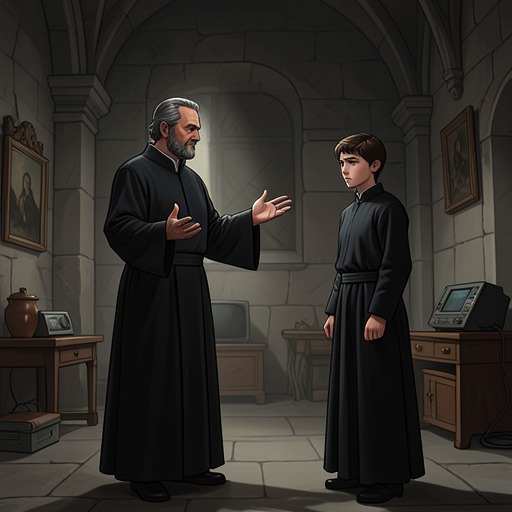
At the time of Goldmund’s youth, two unusually prominent figures give the community a particular character. Abbot Daniel is loved for his kindness, simplicity, and humility, though learned brothers know that he is not a scholar and has only modest Latin. Narcissus, still a novice, has nevertheless been appointed to teach, especially Greek, against custom. His exceptional learning and refinement attract admiration, while his reserve and self-control also provoke resentment. Mariabronn’s religious hierarchy is not merely ceremonial: status and authority shape who teaches and who decides. When Narcissus and Father Lorenz dispute how grammar should be taught, their argument is submitted to Abbot Daniel, who hears them patiently.
Goldmund’s Early Life and Departure
Mariabronn is the setting of Goldmund’s education and of his formative friendship with Narcissus. Goldmund later understands that his earlier diligence was bound up with his desire for Narcissus’s esteem: love had given him the will to study, even subjects for which he had no lasting vocation. Narcissus eventually tells him that their friendship has reached one goal—Goldmund has been awakened—and urges him to seek his mother’s image and listen to it. Narcissus, by contrast, remains committed to the cloister and its vows. He intends to withdraw from teaching before his consecration for a period of fasting and exercises, during which he will avoid worldly conversation, including with Goldmund. Their different paths bring the friendship to a painful pause without extinguishing Narcissus’s affection.
Years later, Goldmund’s memory of Mariabronn returns during his wandering. After a night of dreams, he enters a cloister, attends mass, and remains in the church, moved by memories of the cool stone interior and the sounds of the corridors. He feels an urge to confess and to change his life, especially burdened by the death of Viktor, whom he killed. The setting briefly reconnects the wanderer to the religious practices of his youth, though his experience of confession belongs to another cloister rather than to Mariabronn itself.
The cloister also remains an imagined destination during his years away. While living with Lene, Goldmund thinks of leaving when the weather turns cold, returning to Master Niklaus for the winter, and walking to Mariabronn the following spring to see Narcissus. The plan reveals that the place and his friend continue to offer a point of orientation even when Goldmund’s life is elsewhere. His return is not yet certain, but the wish to see Narcissus again persists amid the temporary shelter and relationships of his wandering.
Memory, Art, and the Return
Goldmund’s artistic vocation develops elsewhere, but Mariabronn’s art becomes part of the history through which he understands it. Before he returns, he passes a church whose old stone figures recall sculptures he had seen at Mariabronn as a boy. His judgment of such work has changed more than once: first he found the figures dignified but stiff, then preferred the livelier art associated with Master Niklaus, and now, after years of experience, he is moved by the ancient figures’ endurance. Their carved forms seem to preserve the fears and hopes of generations long gone. In the empty church, unable to find a priest, he kneels at an unoccupied confessional and confronts his life through prayer. The episode prepares his return by making old religious art newly legible to him—not as outdated decoration, but as a durable human answer to time and loss.
When Goldmund finally reaches Mariabronn with Narcissus, he dismounts beneath the chestnut tree and touches its trunk. He picks up one of the split, withered husks from the ground. The gesture joins the remembered place to the passing of time: the tree remains, but what it bears has fallen and dried. At first Goldmund stays in a guest cell; at his request, he is then given a room in an administrative building across from the forge, around the main yard.
The homecoming affects him with unexpected force. He feels recognized by the courtyard trees, portals, windows, mill, water wheel, corridor flagstones, rosebushes, and storks’ nests, although the people there do not know who he is. Ordinary sounds and details return with his memories: bells for evening prayer and Sunday mass, the millstream, sandals on stone floors, the porter’s keys at night, familiar plants beside the stone gutters, and the little school bell announcing recess. Seeing the boys, he wonders at the distance between their apparent youth and his own former childhood. Mariabronn is familiar, but Goldmund is no longer the boy who left it.
His return also changes how he sees the cloister’s artistic inheritance. He recognizes the beauty of its buildings, paintings, and figures in church portals and on altars, and understands that their works belong together as products of a shared spirit developed over centuries. An old stone Mother of God that he had liked and copied as a boy now appears to him so beautiful that he doubts his own best work could surpass it. The cloister’s unity is not simply architectural: buildings, sculpture, painting, worship, thought, and teaching seem to have grown from common roots. Goldmund feels small within this enduring order, particularly when he sees Narcissus governing it as Abbot John. Though Abbot John differs in character from the kindly, simple Abbot Daniel, both serve the same institutional unity and subordinate themselves to it.
Work and Renewal
Goldmund’s return is accompanied by a need to work, not merely to revisit his past. He tells Abbot John that he cannot bear to remain beside him without making or doing something of his own. Narcissus advises him to remove the obstacles between himself and his work and to find or build a workshop. Goldmund takes up the suggestion practically: he finds an empty shed beside the courtyard gate, orders a drawing board and tools made to his own plans, arranges for materials to be brought from nearby cities, selects timber at the carpenter’s and in the forest, and stacks it under a roof he builds behind the workshop.
The forge becomes part of this preparation. Goldmund works with the smith to make the knives, chisels, drills, and planes he needs. The smith’s son, Erich, becomes his friend and assistant, helping with the preparations and sharing his interest in carving. Goldmund promises to teach him the lute and lets him try carving. Telling Erich stories about Master Niklaus and the bishop’s city, Goldmund can feel like an old man recounting a life already spent; yet he also feels that his true life may only now be beginning. The workshop and its materials give his return a forward direction rather than leaving it as nostalgia.
His first commission is chosen to belong to Mariabronn’s existing life. Since the cloister needs neither a new altar nor a pulpit, Goldmund settles on the unornamented niche in the refectory where a young brother reads from the lives of the saints during meals. He plans wooden panels for the lectern and its steps, with figures in half-relief and in more fully projecting forms. The design joins the created world to the word of God: an oak trunk forms the basis of the stairs, which are to carry scenes of nature and the simple lives of patriarchs and prophets; above, the parapet bears the four apostles. Among them, Goldmund intends to represent Abbot Daniel, his successor Father Martin, and Master Niklaus in the likeness of the evangelist Luke. The work thus brings the cloister’s religious setting into contact with the people and artistic relationships that have shaped Goldmund beyond it.
Once work begins, Goldmund withdraws from much of the community’s ordinary social life. After the snow has fallen and Christmas has passed, he is seldom seen around the cloister; he eats at the mill and admits no one to the workshop except Erich. The work absorbs him through difficulties that alternately enchant and discourage him, and he sometimes does not speak to his assistant. The solitude is intense, but it is not absolute: Mariabronn supplies the space, materials, and institutional purpose for his labor, while Erich’s help and Narcissus’s interest maintain human ties around it.
When the lectern is finished and installed, the cloister makes Goldmund’s work public. He is invited to the fathers’ table for a festive meal, where the oldest wine in the house is served and Narcissus praises and honors the work. Yet recognition does not resolve the cost of creation. Goldmund feels the emptiness of the workshop after the work passes into others’ possession, where it will be looked at, judged, and praised. Mariabronn consequently holds both sides of his artistic life: it gives his work a place within a lasting communal order, but the completion of each work leaves him facing the solitude and uncertainty that follow its removal from his hands.